Introduction
In the cultural tapestry of Northeast India, the state of Mizoram boasts a rich heritage shaped by valor, communal harmony, and ceremonial grandeur. Among its myriad traditions, the Khuangchawi ceremony stands as a remarkable testament to the Mizo people’s reverence for bravery, achievement, and social stature. Rooted deeply in Mizo tribal customs, Khuangchawi is not merely a celebration; it is a social milestone and a marker of personal legacy.
The Khuangchawi ceremony historically honored individuals who exhibited exceptional bravery, achieved wealth, or performed deeds of social significance. As a recognition of extraordinary success, it involved elaborate feasts, music, dancing, and public admiration. This blog explores the origins, cultural significance, procedural elements, and contemporary interpretations of Khuangchawi, highlighting its place in Mizo heritage and collective memory.
1. Historical Background of Khuangchawi
The Khuangchawi tradition dates back to the early Mizo tribal societies, when social stratification was minimal, and community recognition played a central role in leadership and influence. In the pre-Christian era, Mizo tribes were organized into clans under village chiefs (Lal), with valor, generosity, and leadership being the core virtues.
In this context, Khuangchawi emerged as a traditional honor accorded to individuals who demonstrated extraordinary bravery in war, hunting, or community welfare. Over time, this recognition extended to include individuals who were wealthy and generous enough to host elaborate feasts or provide for the village in times of need.
In Mizo culture, to be called a Thangchhuah—a title awarded after hosting a successful Khuangchawi—was to be immortalized in folklore and song. The individual and their family not only gained respect but also secured their place in the collective memory of the tribe.
2. Meaning and Etymology of Khuangchawi
The term Khuangchawi is derived from two Mizo words: “khuang” meaning drum and “chawi” meaning to beat or play. Thus, Khuangchawi literally translates to “beating of the drum.” However, its figurative meaning is much deeper. It signifies the announcement or proclamation of greatness—when the drum is beaten for a person, it means they have achieved something worthy of public honor and celebration.
In traditional societies, drums were used not only as musical instruments but also as tools for communication and ceremonial expression. The act of drum-beating in Khuangchawi symbolizes the public declaration of an individual’s stature and heroic feats.
3. Criteria for Organizing a Khuangchawi
Organizing a Khuangchawi was not for everyone. It was considered a rare honor that required the individual or family to meet specific social and economic benchmarks:
- Bravery in Battle or Hunting: Individuals who killed a tiger or a bear, or who proved their prowess in tribal warfare, qualified for Khuangchawi.
- Wealth and Generosity: One had to be affluent enough to host multi-day feasts, provide meat and drink for the entire village, and support festivities involving dance and music.
- Community Welfare Contributions: Leaders who built community granaries, helped the poor, or offered livestock during crises could be considered for Khuangchawi.
The ceremony served as a social leveling mechanism—it rewarded not just wealth, but the use of wealth for the greater good of the tribe.
4. Rituals and Procedures of the Khuangchawi Ceremony
A Khuangchawi was typically a multi-day event, marked by a strict ceremonial order and heavy involvement of the village community. The rituals included:
a. Announcement and Preparation
Once a family decided to hold a Khuangchawi, preparations would begin months in advance. Livestock such as pigs, cows, and mithun (a type of bovine) were reared or bought. Large quantities of rice beer (zu) were brewed. The entire village was informed and a date was set.
b. Feasting and Sacrifices
The Khuangchawi began with feasting. The host would slaughter animals to feed the entire village. A priest (Sadawt) would conduct sacrificial rituals, offering portions to the spirits (Pathian and Pu Vana, the ancestors), believed to bless the ceremony and the host.
c. Cultural Performances
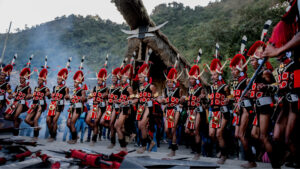
Throughout the day and night, the villagers participated in cultural activities such as:
- Cheraw dance (bamboo dance)
- War dance (Khuallam)
- Folk songs praising heroes and ancestors
Drums, gongs, and flutes filled the air as the community celebrated the achievements of the honored individual.
d. Bestowing the Thangchhuah Title
The culmination of the Khuangchawi was the bestowing of the Thangchhuah title, which meant “one who has reached the pinnacle.” This was often accompanied by the presentation of symbolic attire, such as warrior’s headdress, and the individual’s name would be etched in oral history.
In traditional belief, only a Thangchhuah could expect to ascend to Pialral—the Mizo paradise—after death.
5. Social and Cultural Significance
The Khuangchawi was not just a display of wealth; it was a deeply social, spiritual, and moral event. Its significance can be understood through the following lenses:
a. Reinforcing Community Bonds
By feeding and entertaining the whole village, the host displayed a sense of responsibility and unity. The Khuangchawi thus acted as a form of social investment, strengthening communal bonds.
b. Preservation of Oral Traditions
Through songs, dances, and storytelling, the values of bravery, generosity, and leadership were passed down from generation to generation.
c. Spiritual Recognition
The Mizo belief in Pialral gave the Khuangchawi spiritual weight. The individual was not just being honored in this life but was believed to be granted favor in the afterlife.
d. Cultural Continuity
The Khuangchawi ceremony helped preserve the unique elements of Mizo identity—rituals, language, attire, and social ethics. Even as the external world changed, these traditions anchored the community to its roots.
6. Khuangchawi in the Modern Era
With the advent of Christianity in Mizoram during the late 19th and early 20th centuries, many traditional practices, including Khuangchawi, began to fade. The Christian missionary influence discouraged ceremonies involving animal sacrifice and communal drinking.
However, the spirit of Khuangchawi did not disappear. Instead, it adapted:
- Church and Community Recognition: Today, individuals who serve society through welfare, education, or church leadership are publicly honored, echoing the Khuangchawi ethos.
- Cultural Revivals and Festivals: During cultural festivals such as Chapchar Kut, elements of the Khuangchawi—including traditional dances, music, and attire—are revived for educational and celebratory purposes.
- Modern Honors: The Mizoram state government and cultural organizations often recognize outstanding citizens through awards and ceremonies that retain the essence of Khuangchawi.
The shift from a ritualistic to a symbolic and civic version of Khuangchawi illustrates the dynamic nature of Mizo culture—retaining core values while adapting to contemporary frameworks.
7. Comparisons with Similar Traditions
The Khuangchawi ceremony finds parallels in other cultures that honor heroic or philanthropic individuals through public ceremonies:
- Potlatch (Pacific Northwest Tribes): Like Khuangchawi, Potlatch involved feasts and gift-giving to establish social rank and community esteem.
- Feasts of Merit (Naga tribes): Wealthy or brave individuals among the Nagas hosted feasts and earned symbolic titles.
- African Chieftaincy Ceremonies: In various African cultures, communal feasts and dance rituals accompany the honoring of brave or generous leaders.
These comparisons highlight the universality of communal recognition as a social tool.
8. Educational Value and Cultural Preservation
Understanding Khuangchawi offers numerous educational insights:
- Anthropological Understanding: It gives us a window into the socio-political and moral frameworks of tribal societies.
- Cultural Preservation: Documenting and teaching about such traditions helps preserve indigenous knowledge and heritage.
- Moral Education: The values of courage, generosity, and public service promoted through Khuangchawi remain relevant for modern civic life.
Schools, colleges, and cultural organizations in Mizoram now include Khuangchawi in their curriculum and public events to ensure that the youth stay connected to their ancestral traditions.
Conclusion
The Khuangchawi ceremony stands as a symbol of the Mizo community’s respect for valor, generosity, and social commitment. Far more than a feast or celebration, it was a deeply spiritual and social rite that linked personal success with community welfare. While modernization and religious transformations have altered its expression, the spirit of Khuangchawi remains etched in the Mizo collective consciousness.
Today, as cultural identity becomes increasingly important in a globalized world, the Khuangchawi tradition continues to inspire generations by celebrating not just success, but the ethical use of success for the benefit of the community. In doing so, it keeps alive the rhythm of the drum—khuang chawi—resonating through the hills of Mizoram and in the hearts of its people.